
New enforcement regulations laid in Parliament
The statutory instrument (SI) to make a number of changes to the Taking Control of Goods regulations, including a 5% increase in enforcement fees for both civil and High Court enforcement, was laid before Parliament on 26th March 2026, almost three years after the consultation.
The new regulations – The Taking Control of Goods (Miscellaneous Amendments) Regulations 2026 – will come into force on 1st May and will apply to warrants and writs of control lodged with the enforcement company on 1st
May and onwards.
Any warrants, liability orders and writs received by the enforcement company prior to 1st May will proceed to conclusion using the old fee scale.
Notice of enforcement
The SI brings in some positive changes, including the increase in the time given during the compliance period, directly after the notice of enforcement (NoE) has been issued. This period has increased from seven clear days to 14 clear days, which will help more debtors to pay their debt, without out incurring additional enforcement fees.
If a debtor is working with a debt advice provider, they may apply to extend the notice period to 28 days, before the expiry of the NoE. This applies to debtors and debt types that are covered within the Breathing Space legislation introduced in 2020.
Linked cases
Multiple cases against the same debtor will continue to be linked as previously.
If there are two cases, for example, the first being instructed prior to 1st May and the second after 1st May, when these cases are linked and enforced together, the old fee scale will be used for enforcement and sale or disposal, including the old £1,500 threshold for the percentage fee.
However, the new compliance fee will apply to the post 1st May instructed warrant.
Civil enforcement - fee increase
We do welcome the 5% fee increase, but it is not in line with inflation (cumulative UK inflation from April 2014 to present is around 40-43%), nor does it take into account other increases in business costs, such as employer’s national insurance.
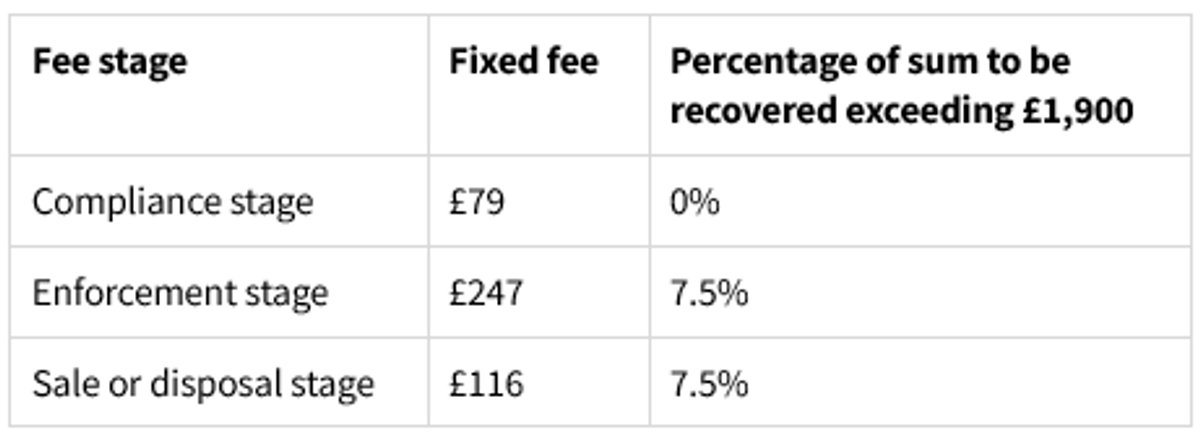
The increase in the threshold before percentage fees can be applied in the enforcement stage and the sale or disposal stage has increased from £1,500 to £1,900, the net effect of which is a reduction in enforcement fees.
The new fees are:
High Court enforcement – fee increase and clarification on enforcement stage 2
The High Court enforcement fees have also been uplifted by 5% and the sale or disposal stage threshold has increased from £1,000 to £1,200.
The new fees are:
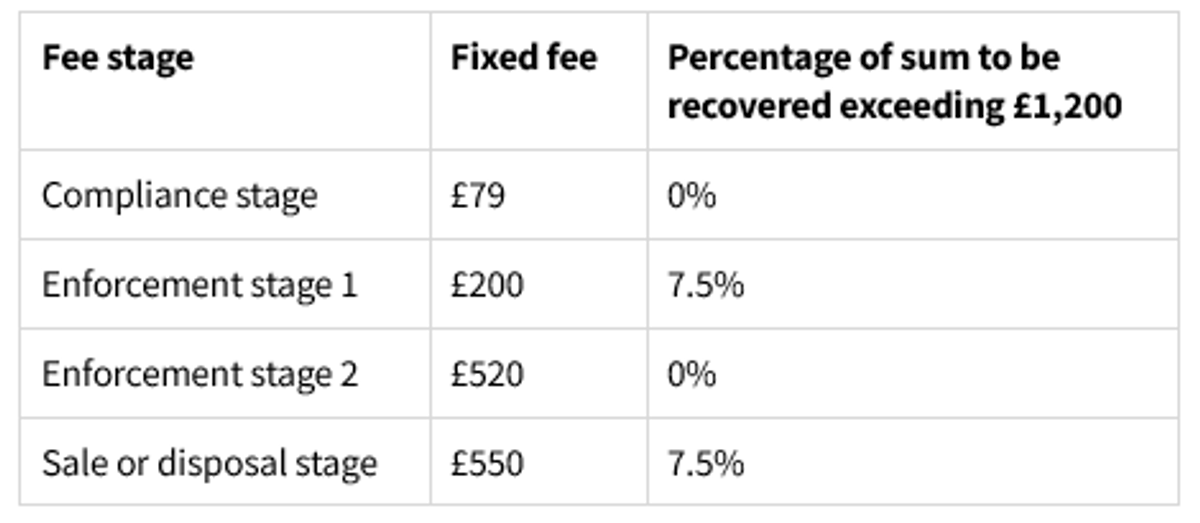
The SI provides welcome clarification about when an enforcement agent can move from enforcement stage one to enforcement stage two. The High Court Enforcement Officers Association will be publishing a best practice document within the next few weeks to give enforcement companies guidance on how to implement fees under the amended regulations.
Frequency of fee increases
When the Taking Control of Goods regulations came in in April 2014, the intention was that the enforcement fees would be reviewed annually. But this has never happened and this SI will bring in the first fee increase in 12 years.
The enforcement industry was hoping that this new SI would include a mechanism for routine fee increases, as is the case with HMCTS court fees (which are reviewed every two years). Unfortunately, this has been omitted, which is of concern to the industry in this period of higher inflation. However, we have been advised that the fees will be reviewed in May 2029.